| Geo. H.W. BUSH | 1 | 2 | 3 | 4 | 5 | 6 | 7 | (don't know/refuse) |
|---|---|---|---|---|---|---|---|---|
| avg=3.58 | 25.2% | 9.4% | 10.3% | 19.2% | 13.1% | 8.4% | 11.7% | 2.0% |
| Wm.J. CLINTON | 1 | 2 | 3 | 4 | 5 | 6 | 7 | (don't know/refuse) |
|---|---|---|---|---|---|---|---|---|
| avg=4.08 | 19.0% | 7.3% | 10.1% | 15.9% | 14.2% | 14.3% | 15.7% | 0.0% |
| #Voters | Their votes |
|---|---|
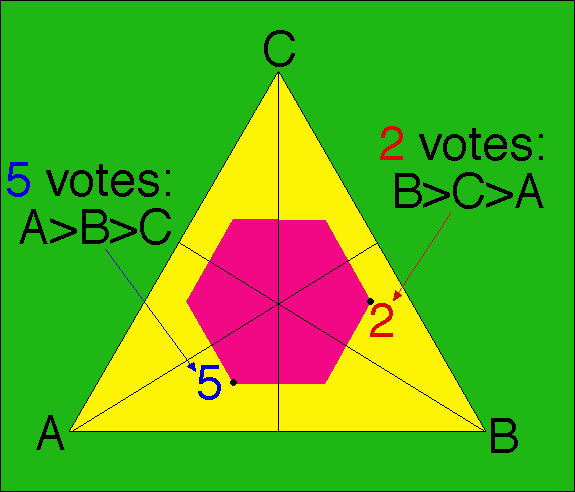
| 3 | A>B>C |
| 2 | B>C>A |
| 2 | C>A>B |
So by Saari's very own "optimality" criterion, range voting is better than Borda voting.
But Saari did not mention that. (And his "proof" began by defining Range Voting "not to be" a voting system.)
Incidentally, another interesting analysis [Davide P. Cervone, Wm. V. Gehrlein, Wm. S. Zwicker: Which scoring rule maximizes Condorcet Efficiency?, Theory & Decision 58 (2005) 145-185] asks which WPV system maximizes the chance of electing a "Condorcet winner." Surprisingly (and contrary to a previous wrong article) the answer is not the Borda count. See puzzle #88.
One might, therefore, by analogy, speculate that some other voting system than range voting – specifically, involving some monotonic but nonlinear pre-transformation of vote-scores – would be better than plain range voting by this measure (with some utility-generator probabilistic model). However, that does not happen because with range voting any voter is free to perform any such transformation already. Thus plain range voting, if all voters "honestly and altruistically" decided to behave that way, would automatically maximize this (or any other) quality measure over the whole space of transformations. (This remark would, presumably, actually yield even better range voting "Bayesian regret" scores for honest voters than the ones measured, which already were better than all common-rival voting systems.) Meanwhile with Borda, voters cannot effectively "change the rules" in this way; they are stuck with Borda weights.
Saari's proof Borda is forced by Arrow-like conditions
Saari has his own version of Arrow's Impossibility Theorem, and a way to redo it so that Borda is the only voting system the (revised) conditions allow. We now explain that and explain why it is stupid.
Here's Saari's wording of Arrow's theorem:
- Assumption #1:
- The votes are (strict) rank-orders of all the candidates. [Note: Immediate consequence: range voting is "not" a voting system.]
- Assumption #2:
- The output of the voting system is a rank-order of all the candidates.
- Assumption #3a:
- The societal ranking (i.e. output of voting system) of any pair A,B is determined solely by how the voters rank that pair.
- Assumption #3b:
- Unanimity on A,B implies the outcome must rank A,B that same way.
THEOREM (Arrow): If #candidates≥3 and #voters≥2 then any voting system obeying all these conditions must be a "dictatorship" (meaning a single voter, the "dictator," exists who has the power to decide who wins regardless of what the other voters do).
Saari then considers replacing assumption #3a with his alternative SAARI-ASSUMPTION-3a: The societal ranking of any pair A,B is determined solely by how the voters rank that pair and by the number of candidates they rank between A,B.
CONCLUSION (Saari): With this revision, Borda voting obeys all the conditions, and if a few extra assumptions also are added (the "anonymity" assumption that all voters are equivalent, is one; he says the others are "technical") Saari concludes Borda is the only voting system satisfying these assumptions.
Why this is stupid: Saari is specifically artificially constructing his axiom to get Borda out, rather than constructing reasonable axioms and then seeing what results. His SAARI-ASSUMPTION-3a is preposterous because it is not something we want a voting system to obey, it is something we want a voting system to disobey! Several papers have been written about how immunity to candidate cloning is a desirable property of a voting system. But here Saari is specifically demanding that the voting system be vulnerable to cloning, unlike the previous authors who (more reasonably!) had demanded exactly the opposite.
In other words, Saari just proved Borda is a uniquely bad voting system. But he then failed to cite or mention all of the previous anti-clone authors (e.g. his book Decisions and Elections fails to cite Tideman or mention the whole cloning concept!??) and thus regarded Borda as a "success."
Saari's revised condition 3a is, of course, actually the introduction of an estimate of preference strength. The problem is that it regards "number of candidates" as preference strength. If we genuinely introduce preference strength, you get range voting. Indeed, in a paper by Dhillon and Mertens which Saari as usual failed to mention or cite, a revised version of Arrow's conditions, this time reasonable, is used to show that (normalized) range voting is the unique voting system obeying the conditions. Also, range voting obeys Arrow's original "impossible" conditions with some authors' wordings (but not Saari's wording) of the theorem. And Range voting is cloneproof. Saari fails to mention any of that.
Is Saari an unmitigated evil?
The tongue-in-cheek heading here is based on a paper Saari authored "Is approval voting an unmitigated evil?".
The answer (to both questions!) is "no." Saari has good points. When he proves a theorem, it is usually a valid theorem.
But counterexamples exist. E.g. see puzzle 46(a) for an apparently false theorem "proved" by Saari; Saari would not have made this error had he done some computer simulations, but he seems allergic to them. Saari's section 7.2.1 of part II of his January 2000 Economic Theory paper is entirely wrong. It describes (in a way hard to follow unless you understood the whole rest of his development) how to construct N-candidate IRV (instant runoff) elections which are "basic profiles" (i.e. all weighted positional and all pairwise methods agree on the winner and on the finish order) where the IRV winner is the candidate they all rank last, and the IRV elimination order is exactly their finish order, i.e. IRV is maximally insane in the view of all these other voting methods. Saari's construction is inductive on N. The only problem is that his whole claim is false for every N: Proof: IRV cannot eliminate the plurality-voting winner in the first IRV round (and plurality is a weighted positional voting method). Q.E.D. It would be interesting to know what (if anything) can be salvaged from Saari's line of reasoning.Saari sometimes proves some quite difficult and powerful theorems too. He has ability. His voting books are usually pretty fun to read and have educational value. We are just warning the reader to keep in mind the defects of Saari's work, which unfortunately also are numerous. Specifically, his books are neither complete nor unbiased. They indeed – and to a degree which can be absolutely absurd – fail to cite notions and papers showing results which do not conveniently fit into his biased worldview.
Post Mortem: Saari spent his life solving the wrong problems, then was too pigheaded to escape his self-created trap
Reviewing the above, there is a unified theme. Saari spent his entire voting-research career solving the wrong problems. Sometimes he did so quite impressively (but so what?). And then, once he'd gotten the idea in his head that Borda was the best voting system, he often ignored and refused to cite (large) evidence to the contrary. If other experts wrote to him who had different views, Saari would insult them and refuse to have anything to do with them. (I know, because I personally experienced this, and I keep encountering others who have experienced the same treatment.) That's sad.
What do we mean by "wrong problems"? The right problem is: what is the best voting method? The way to measure "best" is: Bayesian Regret. This is a large framework within which somebody like Saari could have worked.
As far as I can tell (2008), in Saari's entire (large) publication record, he has never mentioned Bayesian Regret. Ever. Not to praise it, not to criticize it, not to use it at all. I see no evidence he even knows what it is. Indeed, Saari stated during his April 2008 radio appearance he had never read my paper on the subject, despite me bringing it to his attention years previously and him telling me what an idiot I was for writing that paper.
Therefore, without the right yardstick for measuring voting system quality, Saari was forced to employ other, wrong, yardsticks. (Not once in his entire opus did Saari ever make a serious comparative consideration of what a "good yardstick" even would be. As far as I can see, he simply assumed whatever felt intuitively interesting to him, must be a good one.) Examples of wrong yardsticks include: requiring "reversal symmetry." Or requiring a small "dictionary." Or demanding rank-order voting or demanding weighted-positional voting systems while ignoring all others for no reason. These all were moves Saari made at one point or another. Now reversal symmetry sounds good, and presumably has some correlation with something good. But it is not the right thing. And a small dictionary also presumably has some correlation with something good. But it too is not the right thing. (To make an analogy, it is something like deciding grocery store A is better than B because it stocks more kinds of food, while ignoring the quality, price, and demand for those foods. Some correlation with the right judgment? Yes. The right judgment? No. And if you define 90% of all grocery stores not to "be" grocery stores because they do not have a red sign, that makes things worse...) And no matter how many times Saari creates some odd definition of some measure of voting system goodness, and then tries to optimize it, and no matter how ingenious he is when he does so, it will still be solving the wrong problem unless he (one day) makes connection to the correct yardstick, Bayesian Regret. Which Saari, so far, apparently does not understand. One could conjecture that this is because Saari is uneducated about Bayesian statistics and utility theory, which is the area that formulates notions of what it is to be "best."
Not only did Saari employ the wrong yardstick, he also in most or all of his work, optimized that wrong yardstick within a teeny tiny subclass of all voting systems, the weighted positional systems. He then often, in public statements, pretended that subclass was actually the full class. That is simply false. Here is a recent example. In a 15 October 2008 interview of Saari in IndyWeek, Fiona Morgan asked
Q. What system would best reflect voters' views?
Saari's answer: This is a mathematical problem that took well over 200 years to be resolved. I solved it within the last several years. It turns out that the system that most accurately reflects the views of the voters is the Borda count.
That was Saari's full statement. It not only is undefined (what might "most accurately reflects" mean?) it also has the disadvantage of being false. To see that, consider for maximum simplicity, an election with only single voter. The voter with Borda rank-orders all the candidates, e.g. Bush=2, Nader=1, Gore=0. With Range Voting she provides scores for all candidates, e.g. Bush=9, Nader=8, Gore=0. Which is a "more accurate reflection" of the views of that one voter?
And again in a video-recorded lecture "Chaotic Elections" by Saari as the "Scope lecture" on 11 October 2008 at NC State University, he says at 46:46, "The Borda count is the unique choice where the outcomes reflect the voters' views." At 49:31 he was asked "Do I understand you right that a true fair election is to do it by the Borda count?" His answer: "Correct. The Borda count has some anomalies, but we know what they are and we know how to handle them. Any other procedure you have – any other procedure – there is a strong probability that you are going to have an outcome which does not satisfy any consistency statement... where the outcome just clearly is off." This answer by Saari is false and unjustified because his repeated-for-emphasis phrase "any other procedure" is false since his work only was able to consider an extremely tiny subset of all procedures, in particular excluding range voting.
What does Saari think of range voting? In the same lecture at 56:40, Saari was asked about strength of preference. The questioner indicated "Mother Teresa" might be a lot better than somebody, not just 'better,' and Borda offers no way for a voter to indicate that" (unlike range voting). Saari then responds that the system where you have 10 points and can allocate them any way you want (this vague description sounds like cumulative voting) is unbelievably bad. Why do we know it is bad? "Because a version of it was used in figure skating." (Strange: Saari now seems to be mentally switching from cumulative to range voting without realizing they differ? Or without realizing that this difference might be important?) Then Saari laughs and says "enough said." That was his full answer. However, I'm afraid I cannot agree with Saari that this answer suffices. Indeed, figure skating after switching away from range voting got repeatedly embarrassed by events in which A finished ahead of B... until C skated, at which point magically the system decided B was ahead of A. That problem cannot happen with either ordinary or trimmed-mean range voting but can and does happen with Borda. The figure skating association finally decided this "switcheroo" behavior was unacceptable, i.e. Borda was unacceptable, and they switched to another system designed to eliminate it. (However, the replacement was misdesigned and thus actually did not eliminate it, but that is another story.)
I've put this bluntly. At the bottom it is simple. Saari keeps solving the wrong problem in a teeny tiny (so tiny it is almost irrelevant) subclass of all voting systems. He is quite able at it. He then announces his solutions very loudly to all kinds of Media, publishes Books, and gets a lot of attention, all the while pretending he has solved The Great Problem open for 200 years of finding The Best Voting System, and wonder of wonders, it is the (embarrassingly bad) Borda system. He then repeats the process. Saari is by no means the only voting researcher who has solved problems and proved various voting systems "optimal" in various (also wrong) senses. Indeed, I think the Condorcet/Young optimality theorem for Condorcet voting is considerably more appealing than Saari's Borda theorems – the sense in which it is "optimal," which concerns "probability of electing the 'wrong' winner" rather than Bayesian Regret, is still wrong but seems closer to what matters than e.g, Saari's "dictionary size." Saari generally does it for Borda voting and the others for other voting systems (and then Saari generally refuses to cite those other works). Saari just tries to get, and gets, more attention than most.
Some important Saari publications
Donald G. Saari:
A dictionary of voting paradoxes, Journal of Economic Theory 48,2 (1989) 443-475.
Explaining all Three-Alternative Voting Outcomes,
J.Econ.Th. 87 (1999) 313-355.
Mathematical structure of voting paradoxes,
I. Pairwise votes, Economic Theory 15,1 (2000) 1-53.
II. Positional voting, Economic Theory 15,1 (2000) 55-102.
Decisions and Elections: Explaining the Unexpected,
Cambridge University Press, 2001.
Geometry of Voting, Springer Verlag, 1994.
Saari has published somewhere in the neighborhood of 50 papers on voting. But the papers listed above constitute (what apparently Saari regards as) his greatest accomplishment: they reach an essentially complete understanding of the full set of every logical "Saari-paradox-type" suffered by every weighted positional rank-order voting method (and his techniques also tell us quite a lot about paradox types in certain other kinds of rank-order-ballot voting methods too). Saari shows that every Saari-paradox-type suffered by the "Borda count" is also suffered by every weighted positional voting method, so that Borda is the one with the fewest paradox-types. Indeed, Saari shows that almost every weighted positional method suffers every thinkable kind of paradox. In the 3-candidate case, every weighted positional method except Borda suffers every thinkable kind of paradox (according to Saari's notion of what a "paradox-type" is – which is however an incomplete notion since for example non-monotonicity is a kind of paradox inadmissible as far as Saari's enumeration is concerned).