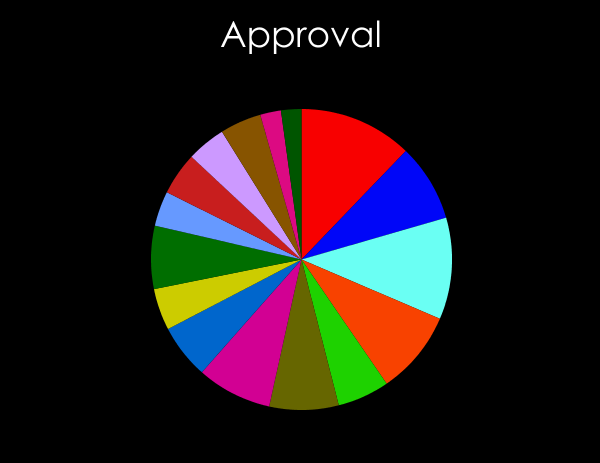
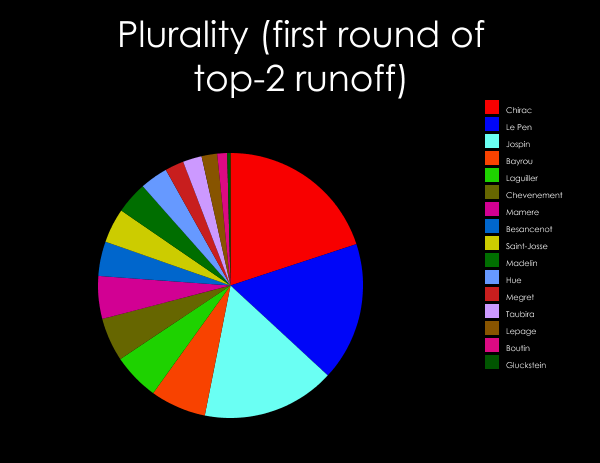
The largest study contrasting approval voting with plurality voting in
an important actual election was for the French Presidential Election (non-runoff round)
of 2002. Here is an abbreviated English-language version of their paper:
They conducted an approval-voting pseudo-election in parallel with the genuine French
(plurality-style) election, using several thousand voters, all of whom were
also actual voters in the real election. Here are their results (listed in order
of finish in the official plurality election).
2002 results:
#
Candidate
Approval
Finished(AV)
Plurality
1
Chirac
36.7%
1
19.9%
2
Le Pen
25.1%
4
16.9%
3
Jospin
32.9%
2
16.2%
4
Bayrou
27.1%
3
6.8%
5
Laguiller
16.8%
9
5.7%
6
Chevenement
22.4%
6
5.3%
7
Mamere
24.3%
5
5.2%
8
Besancenot
17.6%
8
4.2%
9
Saint-Josse
13.5%
11
4.2%
10
Madelin
20.4%
7
3.9%
11
Hue
11.3%
14
3.4%
12
Megret
13.8%
10
2.3%
13
Taubira
12.6%
13
2.3%
14
Lepage
13.4%
12
1.9%
15
Boutin
6.7%
15
1.2%
16
Gluckstein
5.5%
16
0.4%
(Total)
315%
100%
As you can see, with Approval Voting the election results – not only the top two, but
in fact all the way down the line – would have been dramatically
different. This illustrates the tremendous distortions caused by
strategic-voting effects,
"vote-splitting" effects, and
"cloned candidate" effects with plurality voting; such bad effects tend to be
even more shriekingly obvious in elections like this one (we expect similar effects
in the
Iowa 2008 Presidential Caucuses)
which include many
viable candidates.
Under the French rules this (plurality) election was close enough that by law, a second
"runoff" election needed to be held between the top two plurality finishers Chirac and Le Pen.
The fact that Plurality (in the election above) had produced a tremendously distorted result
ranking Chirac and Le Pen as "close,"
was proven by the fact that in the runoff, Chirac beat Le Pen by
an enormous
margin of 82.2% to 17.8% (far greater than the largest landslide ever in any US presidential
election, which was only about 60%). As you can see, even Approval Voting's (less distorted)
results still were somewhat
distorted as far as what you might have expected about Chirac
versus Le Pen is concerned.
That appears to be because of "strategic approval voting" where most voters approved
just one of {Jospin, Chirac} not both,
figuring since they were going to be the top two,
it was best to thus-maximize their vote's "impact."
(See, e.g, the "Matrice des associations" in the
paper for data backing that sort of contention up – only 15
out of 2587 voters approved both Chirac and Jospin.)
Probably
Range Voting
would have behaved better in that respect since with range voting voters would have
had the option of
being "more honest" in their vote. For example, a range voter (using 0-to-99 score range)
who scored Chirac=99, Jospin=83, would with approval voting be "strategically forced"
to approve Chirac but not Jospin in order to have nonzero impact on the Chirac-vs-Jospin battle.
With range voting, an honest vote would have an impact on this battle; with approval voting,
it would have zero. Also with range voting, a voter could distort her vote
(e.g. Chirac=99, Jospin=60) to get more impact than a fully-honest vote, but more honesty
than a fully-strategic vote. That kind of partly strategic, partly honest vote is possible
with range but not with approval voting.
Another interesting point is that, even with approval voting, no candidate got
more than 37% Approval. Keep that in mind as a counterexample in case somebody claims
that "obviously" some candidate will get more than 50% Approval. Voters are not
necessarily happy about their choices – and whenever that is so,
it will clearly be seen with approval voting.
Number of approved candidates (average = 3.15)
0
1
2
3
4
5
6
7
8
9
10
>10
36
287
569
783
492
258
94
40
16
6
1
5
If the French 2002 election had been held with Approval Voting, the top two instead
would have been Chirac versus Jospin, and quite plausibly the popular former PM
Jospin (who suffered a lot of vote-splitting in the above election)
would have won that runoff, changing
history.
Pre-election polls had shown that a hypothetical Jospin-Chirac runoff
(which was expected –
Chirac vs Le Pen was a big surprise)
would be too
close to call, but it was clear Le Pen would lose big in a runoff with either.
Jospin may have had a slight edge over Chirac:
In their last 12 predictions – late February to the election – the TNS-Sofres
polls
about a hypothetical Jospin-vs-Chirac runoff showed Jospin winning 8 times, Chirac 2 times, and
a tie twice (suggesting Jospin's chances were 9/12=75%).
However, Chirac supporters could counter that among the last 4 polls, Chirac won 2
and tied 2, suggesting Chirac's chances were 75%!
Within the full set of 25 Sofres polls Chirac won 8 and Jospin 12,
with 5 tied, which would suggest Jospin's chances were 14.5/25=58%,
which is also about what you get if you take an weighted average of all the 25 polls
weighting the more-recent ones heavier, hence is my best guess.
2e tour
Source: Enquêtes Sofres réalisées pour LCI, Politique Opinion et Le Nouvel Observateur Le 21 avril, la question était : "Au deuxième tour de l'élection présidentielle, pour quel candidat y a-t-il le plus de chances que vous votiez?"
2-3
fév
2001
28-29
mars
2001
15-16
mai
2001
22-23
juin
2001
7-8
sept
2001
29
oct
2001
22-23
nov
2001
6-7
déc
2001
5
jan
2002
14-15
déc
2002
11-12
jan
2002
1-2
fév
2002
13-15
fév
2002
22-23
fév
2002
Jacques CHIRAC
47
48
50
49
49
52
51
52
51
51
51
50
50
49
Lionel JOSPIN
53
52
50
51
51
48
49
48
49
49
49
50
50
51
Jean-Marie LE PEN
-
-
-
-
-
-
-
-
-
-
-
-
-
-
27-28
fév
2002
8-9
mars
2002
14-15
mars
2002
13-16
mars
2002
22-23
mars
2002
27-28
mars
2002
27-28
mars
2002
3-4
avr
2002
10-11
avr
2002
13-15
avr
2002
17-18
avr
2002
21
avr
2002
Résultats
5 mai
2002
Jacques CHIRAC
49
48,5
49,5
49
49
49
48
51
50
51
50
78
82,2
Lionel JOSPIN
51
51,5
50,5
51
51
51
52
49
50
49
50
-
-
Jean-M. LE PEN
-
-
-
-
-
-
-
-
-
-
-
22
17,8
The reason Jospin would have done better in a runoff versus
Chirac than he did in the
first round was that Taubira's and Chevenement's first-round voters
generally preferred Jospin>Chirac.
A strategic ploy which probably both happened and worked:
Another interesting possibility is that some
Chirac voters may have intentionally voted for Le Pen
figuring that way Chirac would beat Le Pen in the runoff, whereas
Chirac was much less likely to
defeat Jospin in the runoff.
Think that's unlikely? Wrong:
In the 2007 French election 10-31% of voters of various types admitted, when asked by the
TNS-Sofres polling agency, that they strategically lied
in their first-round vote; in 2012 this percentage was 20.
If so, the 2002 election was a case where voting for the
worst candidate in
that voter's view, was actually superior strategy to voting for her best choice.
My personal estimate/guess is this strategy was used, and did succeed
in keeping Jospin out of the runoff, and more probably than not
Jospin would have won that runoff.
In other words, my best guess is
this strategy was used, and actually worked.
That's an example of one common runoff pathology which never arises with (single round)
approval and range voting.