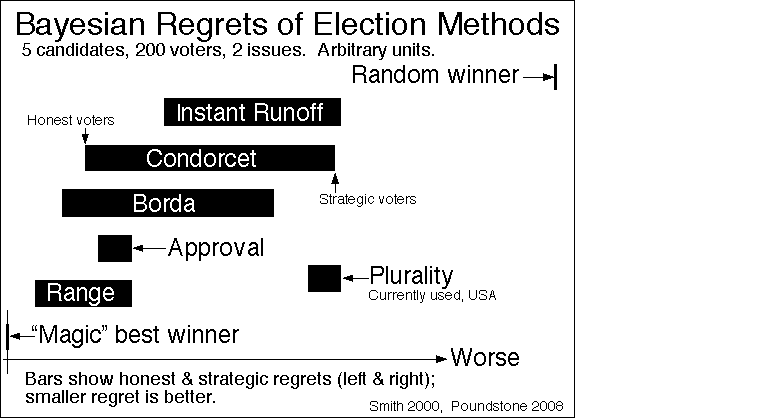
"Bayesian regret" is the "gold standard" for comparing single-winner election methods.
Roughly, the "Bayesian regret" of an election method E is the "expected avoidable human
unhappiness" caused by using it.
The Bayesian regret of E can be mathematically defined.
It can be measured quantitatively by computer simulations.
No assumption need be made that voters are "sincere" or "well informed."
Bayesian regret can be evaluated for any kind of voter strategic behavior and any
level of voter informedness.
No simplistic probabilistic assumption need be made such as
that we have "random uniform elections" ("impartial culture"); you can put in arbitrarily
sophisticated probability distributions, "issue spaces," "utility generators," etc
(and we have done quite a lot of that including
IEVS features the world's first "reality based" statistics)
Even if utilities for different humans
are regarded as inherently unknowable, unmeasurable, and
inapproximable by any physical/biological process,
that would not affect the validity
of the Bayesan Regret methodology and its conclusions one iota.
Those measurements have been done
and range voting is robustly the best
single-winner voting system (i.e. has the least Bayesian regret) among
all commonly proposed alternatives.
Bayesian Regrets values are "meaningless numbers"? Well, no. They're deaths. Wasted money.
Illness. Crimes. Devastation. Poverty.
Bayesian Regret encapsulates everything you don't want. Yes, it encapsulates it
in a number. But that doesn't make it any less real. That makes it more
real because it is quantifiable rather than puffery. Bayesian Regret is plenty real.
As real as your death.